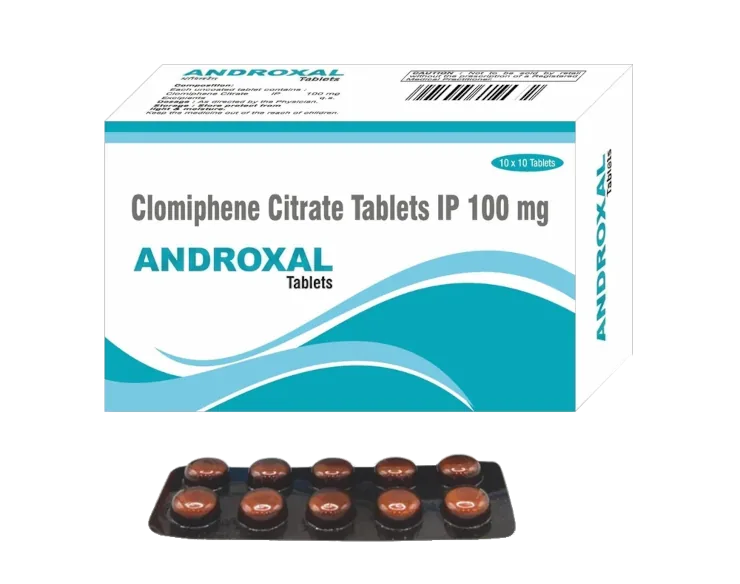
 For informational & educational purposes only
Androxal Key Facts
| Active ingredient | Enclomiphene citrate (also spelled enclomifene) |
|---|---|
| Drug class | Non-steroidal selective estrogen receptor modulator (SERM) |
| Studied for | Secondary (hypogonadotropic) hypogonadism in men |
| Doses studied | 12.5 mg or 25 mg by mouth, once a day |
| Original developer | Repros Therapeutics (Androxal was its development name) |
| US status | Not FDA-approved. Available only as a compounded medicine with a prescription |
| EU status | Marketing authorisation refused (EnCyzix, 2018) |
| Sport | Prohibited at all times by the World Anti-Doping Agency (S4) |
Androxal Product Summary
Androxal (enclomiphene citrate) is an oral medicine that was studied for men with certain types of low testosterone. Instead of supplying testosterone from outside the body, it is designed to help the body produce more of its own.
Enclomiphene is one of the two components of the older drug clomiphene citrate (Clomid). Clomid is a mixture of two related molecules: enclomiphene and zuclomiphene. Enclomiphene is the form that mainly stimulates testosterone production, while zuclomiphene has more estrogen-like effects and stays in the body longer. Isolating enclomiphene was intended to raise testosterone with fewer of the effects linked to zuclomiphene, although this has not been proven in head-to-head trials.
Enclomiphene belongs to a class of drugs called selective estrogen receptor modulators (SERMs), which act on estrogen receptors differently in different tissues. In the brain centres that control hormones, enclomiphene mainly blocks estrogen signals.
How Androxal (Enclomiphene) Works
The body regulates testosterone through a feedback system involving the brain (hypothalamus and pituitary gland) and the testes:
- The brain releases signals called luteinizing hormone (LH) and follicle-stimulating hormone (FSH), which tell the testes to make testosterone and support sperm production.
- Some testosterone is converted to estrogen. When the brain senses enough estrogen, it reduces those signals so production doesn't go too high.
Enclomiphene blocks estrogen receptors in the brain, so the brain reads estrogen as low and increases LH and FSH. The testes then make more testosterone, and sperm production is maintained. This is different from testosterone replacement therapy (TRT), which supplies testosterone directly and usually shuts down the body's own production and lowers sperm counts.
Enclomiphene blocks estrogen receptors in the pituitary gland, reducing negative feedback, increasing LH and FSH secretion, and stimulating the testes to produce testosterone rather than replacing it.
Enclomiphene vs clomiphene vs testosterone therapy
| Enclomiphene | Clomiphene (Clomid) | Testosterone therapy | |
|---|---|---|---|
| What it is | A single isomer of clomiphene (SERM) | A mixture of enclomiphene and zuclomiphene (SERM) | Testosterone itself |
| How it raises testosterone | Increases LH and FSH so the testes make more | Increases LH and FSH so the testes make more | Supplies testosterone from outside the body |
| Effect on sperm production | Maintained in phase 3 trials | Generally maintained | Usually reduced |
| Works in primary hypogonadism? | No | No | Yes |
| How it is taken | Daily tablet or capsule | Tablet | Gel, injection, patch or other forms |
| US approval for male hypogonadism | Not approved; compounded only | Not approved for men (approved for female infertility; used off-label) | Approved |
Who It Is Typically Considered For
Enclomiphene is mainly discussed for secondary hypogonadism (also called hypogonadotropic hypogonadism), where testosterone is low because the brain or pituitary gland is not sending enough signals to the testes. This differs from primary hypogonadism, where the testes themselves don't respond properly.
Low testosterone can cause reduced sex drive, fewer spontaneous or morning erections, low energy or infertility, but these symptoms have other causes too. The Endocrine Society recommends diagnosing hypogonadism only when a man has consistent symptoms and repeatedly low testosterone, and measuring LH and FSH to tell primary from secondary hypogonadism.[8]
Enclomiphene is often discussed for men who:
- have confirmed low testosterone with low or inappropriately normal LH and FSH levels after proper testing
- want to raise testosterone while trying to preserve fertility
- prefer an oral option to injections or gels
It is unlikely to help when the testes cannot respond to LH and FSH, which is one reason a clinician needs to find the cause of low testosterone rather than relying on a single test. Self-diagnosis and unsupervised use are not recommended.
What the Clinical Trials Showed
In two phase 3 trials in overweight men aged 18 to 60 with secondary hypogonadism, men started on 12.5 mg of enclomiphene daily, increased to 25 mg if needed, and were compared with men using testosterone gel or a placebo.[1] The trials found:
- Testosterone rose into the normal range in most men taking enclomiphene.
- LH and FSH rose with enclomiphene but fell with testosterone gel.
- Sperm concentrations were maintained with enclomiphene but fell with testosterone gel.
However, the FDA concluded that the trials did not demonstrate a clinically meaningful improvement in symptoms of low testosterone, and the European Medicines Agency reached a similar view. Results vary between individuals, and long-term data are limited.
Studied and Off-Label Uses
Enclomiphene has no approved use anywhere. It has been studied or used for:
- Secondary hypogonadism: the main use studied in clinical trials, aiming to raise the body's own testosterone production.
- Preserving fertility: as an alternative to testosterone therapy for men who want to keep sperm production; it is not an approved fertility treatment.
- Low testosterone linked to obesity or metabolic syndrome: the main phase 3 trials were in overweight men.
- Recovery after testosterone or anabolic steroid use: sometimes used off-label, but there are no clinical trials for this use and it is prohibited in sport.
Androxal Side Effects and Safety
Side effects reported in studies
- headache
- hot flushes
- nausea
- muscle spasms
- dizziness
- fatigue
Regulators also noted changes in estradiol (estrogen), hematocrit (the proportion of red cells in the blood) and PSA (a prostate blood marker), and occasional vision complaints.
Safety concerns raised by regulators
- Blood clots: the European Medicines Agency cited a risk of venous blood clots when it refused authorisation.
- Heart and clotting risks: the FDA's review discussed possible cardiac and clotting concerns.
- Visual disturbances: blurred vision or light sensitivity can occur with this class of drugs and should be reported promptly.
- Limited long-term data: safety beyond the length of the main trials has not been established.
These concerns need careful medical review; they do not mean everyone who takes enclomiphene will have these problems. Because there is no approved label, there is no official list of who should not take it, no complete interaction list and no standard monitoring plan. Before considering it, discuss your medical history and other medicines with a clinician, especially any history of blood clots, heart or blood-vessel problems, abnormal blood counts, prostate concerns, liver disease or vision problems.
Doses Studied
In the phase 3 trials, men took 12.5 mg by mouth once a day, increased to 25 mg if their testosterone did not rise enough.[1] There is no approved product, so there is no official dose. Compounded prescriptions vary, and the dose should only be set and adjusted by a clinician based on blood tests and response. Do not change the dose on your own.
Monitoring and Practical Considerations
One low testosterone result does not mean someone needs enclomiphene, or any hormone medicine. A clinician will usually consider symptoms, repeat an early-morning testosterone test, and look for the cause, which may involve LH, FSH, other blood tests, a semen analysis or further evaluation.
If treatment is considered, monitoring commonly includes:
- baseline blood tests: total (and ideally free) testosterone, LH, FSH, estradiol, a full blood count, liver tests and, especially in men over 40, PSA
- follow-up blood tests, often 4 to 8 weeks after starting and then periodically
- symptom tracking and, if fertility is a goal, semen analysis
Important cautions:
- Enclomiphene needs functioning testes to work.
- It is not suitable for everyone, for example people with certain liver conditions, a history of blood clots or hormone-sensitive cancers.
- Tell your clinician about all medicines and supplements you take.
- Compounded products are not FDA-approved, and their quality can vary between pharmacies.
Questions to Ask a Clinician About Enclomiphene
- Have my symptoms and repeat blood tests confirmed low testosterone?
- Does my LH and FSH pattern suggest a problem with the brain's hormone signals or with the testes?
- What might be causing my low testosterone, and are there other ways to address that cause?
- How could this affect my fertility, and should I have a semen analysis first?
- What benefits should I realistically expect, and how will we judge whether it is working?
- What safety checks make sense for my health history?
- Is the product an approved medicine or a compounded product, and what oversight applies where I live?
Androxal Regulatory Status
| Date | Event |
|---|---|
| 1 December 2015 | The FDA issued a Complete Response Letter to Repros Therapeutics for enclomiphene (formerly Androxal), stating that the phase 3 study design was no longer adequate to demonstrate clinical benefit.[2] |
| 25 January 2018 | The European Medicines Agency's committee recommended refusing marketing authorisation for EnCyzix (enclomifene), concluding its benefits did not outweigh its risks.[7] |
| 8 June 2022 | The FDA proposed that enclomiphene citrate not be added to the 503A bulks list for compounding, and its Pharmacy Compounding Advisory Committee voted against adding it.[3][4] |
| 14 May 2026 | The FDA's list of nominated bulk substances places enclomiphene citrate in Category 1 (under evaluation).[5] |
United States: No FDA-approved medicine contains enclomiphene. Enclomiphene citrate is listed in Category 1 of the FDA's 503A bulk drug substances list, meaning it is under evaluation; the FDA has said it generally does not intend to take action against compounders using Category 1 substances if the conditions in its guidance are met. This is an interim compounding policy, not approval of enclomiphene as a medicine. Compounded medicines are not reviewed by the FDA for safety, effectiveness or quality before they reach patients.[6]
European Union: Marketing authorisation for EnCyzix, an enclomiphene product, was refused in 2018. The concerns included a lack of evidence that it improved symptoms and a risk of blood clots in veins.
Sport: Selective estrogen receptor modulators, including clomifene and its isomer enclomiphene, are prohibited at all times under section S4 of the World Anti-Doping Agency's Prohibited List.[9]
Bottom Line
Enclomiphene (Androxal) is an oral medicine that, in clinical trials, raised testosterone in men with secondary hypogonadism while maintaining sperm counts. However, it is not approved by the FDA or the European Medicines Agency, the trials did not show a clear improvement in symptoms, regulators raised safety concerns including blood clots, and long-term data are limited. If you have symptoms of low testosterone, the right first step is an assessment by a qualified clinician, including repeated morning blood tests and a full medical history.
